
Platform comparisons
1inch vs Matcha: compare the execution mode before the quote
Compare 1inch and Matcha using the same assets and execution mode, with attention to resolver orders, AMM routing, fees and net output.
Read article →Understand how same-chain routing differs from cross-chain settlement, with attention to asset representations, bridge models and intent-based routes.
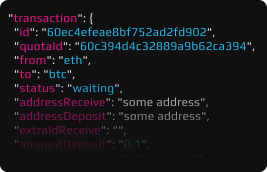
A same-chain swap changes assets within one blockchain network. A cross-chain swap delivers an asset on another network. The destination token contract and network are part of the requested result, not secondary details.
Two tokens can share a name while representing different native, wrapped or bridged assets. Before comparing services, record the source asset, destination asset, contracts, networks and amount. A route that delivers a different representation is not an equivalent quote merely because its ticker matches.
An aggregator can split or use several pools while staying within one network. Its execution conditions can include a minimum received amount and a transaction deadline. The number of route steps does not turn a same-chain swap into a cross-chain transfer.
Compare net output, required permissions, network cost and any service fee. The selected network's current state can affect whether the quoted route remains executable. A research table's supported-chain list describes coverage; it does not demonstrate support for moving assets between every pair of those chains.
Bridge-based paths add bridge-specific contracts and trust assumptions, source and destination execution, and delivery timing. The source transaction being confirmed does not necessarily mean that the destination asset is already available. Check the route's completion, recovery and refund conditions.
Not every cross-chain service uses the same bridge model. For example, 1inch Fusion+ documents intent-based resolver execution with escrow and hash-time-lock settlement. The relevant question is how the particular route coordinates the two sides, rather than whether its interface uses one familiar cross-chain label.
Write down the destination amount after disclosed costs, expected completion conditions, any claim step and the action required if settlement does not complete. Keep separately payable source or destination gas visible. A gasless interface can include that cost in the quote instead of making the economic cost disappear.
Read allowance and refund instructions on the official platform before signing. A change of destination network or asset requires a new comparison. Do not extrapolate a same-chain quoted rate into a cross-chain result by adding a guessed bridge fee.
Filter platforms by documented network support, then verify that the exact source-to-destination product exists. A platform that supports Ethereum and Solana may offer separate swaps on both without supporting the cross-chain trade you intend. The comparison page is a starting reference; current route support and settlement conditions must come from the provider.
Reviewed on 2 October 2026:
Platform comparisons
Compare 1inch and Matcha using the same assets and execution mode, with attention to resolver orders, AMM routing, fees and net output.
Read article →Platform comparisons
Compare CoW Swap signed intents and solver settlement with immediately submitted swaps, including fill conditions, gas and MEV design.
Read article →DeFi research
Understand where a trade happens, what an aggregator routes and what a research dashboard can tell you before comparing protocols.
Read article →